Showing posts with label wildlife watching. Show all posts

Thursday, 4 July 2013

St Ronan's kids are treated to osprey ringing

On Monday 1st July, the chicks from the main osprey nest were ringed. The adult birds, (white leg ring SS) and his un-ringed female are in their tenth season at the nest and this batch of three chicks brings their total number of chicks raised in ten years to 26.

Tony Lightley with pupils from St.Ronan's Primary School

The children from Class P4/5 have been working all summer term on a celebration book for the ospreys 10th anniversary and to thank them for all their hard work and enthusiasm, a special trip was organised by Forestry Commission Scotland to take the children to see the young ospreys being ringed, as they are now six weeks old and soon will be making their first flight.

The chicks were lowered to the forest  floor where Tony Lightley, (Conservation Manager for FCS) and his colleague Ronnie Graham put the leg rings on to the birds, weighed them and measured them. The birds were fitted with unique BTO rings on their right legs, which carry a serial number which identifies the bird and a large Darvic ring on their left leg which is an alpha numeric identification ring which can be read at a distance through a telescope or binoculars, so that birds can be tracked over their lifetime to study their movements and progress in the future.

The class of P4/5 children were further treated, in that Tony arranged for the leg rings to have lettering that relates to their class number. So, the chicks were given rings with the letters CL4, CL5 and the third chick CL6, as the pupils will be moving into Class 6 next term.  It will be lovely if we hear of these birds in the future, whether they return to this area to breed when they are old enough, or if we receive sightings of them wherever they may turn up.  The young chicks will make their very first migration to Africa by the end of this summer, once they have mastered flight and fishing techniques, which their skilled parents will teach them.

Ronan Ted, (the school mascot ) gets a surprise visit too!
Ronan Ted, (the school mascot ) gets a surprise visit too!

The production of the tenth anniversary book has been the joint project between Tweed Valley Osprey Project and the Friends of Kailzie Wildlife, working with the P4/5 pupils of St. Ronan’s Primary School and we received a grant from Awards 4 All to produce 10,000 copies, which will be available from August.
The school have a mascot called Ronan which is a little teddy bear, decked out in school uniform complete with school tie. Ronan Ted accompanied the children on their visit and was treated to a surprise of his own. Tony took him up to the nest for a quick look when he put the chicks back after they had been ringed!

Three ringed chicks back in the nest after ringing.

The children thoroughly enjoyed their visit, it was a very special day out to see such a wonderful osprey family and a thoroughly deserved opportunity for children who have immersed themselves in this project work with so much enthusiasm.
Depute Head, Jan Lister who accompanied the children on their visit said, ‘’ Today has been a great opportunity for the children to see at first hand , the splendour of these young ospreys before they embark on their remarkable journey to West Africa. In school for the last few weeks the children have been learning about the conservation of these remarkable birds and their successful return to breed in the Scottish Borders. Today, that learning was brought to life and has given them many memories which will last a lifetime. We are very grateful for having had this opportunity”.


Wednesday, 26 June 2013

St.Ronan's Primary School guest blog for Tweed Valley Osprey Project

St Ronan's Primary School Osprey Watch visit

The children from class P4/5 visited the Osprey and Nature Watch centre at Kaizlie Gardens to see the ospreys on camera. They got together back at school and wrote a collective piece about thier visit to share with the public on this blog.


Below is their account of the visit:

On June the 6th, P4/5 from St Ronan’s Primary School in Innerleithen went on an adventure to Kailzie Gardens to see what happens at the amazing Osprey Centre.

We saw live footage showing us ospreys, blue tits and herons but the most important thing for us were the ospreys because we are learning about them in our topic.

St Ronan's Primary School Osprey Watch visit
 We saw three baby osprey chicks being fed by the mum. She was giving them raw fish that the dad had just caught fresh from the river. Their mum tore off tiny little scraps of fish, the right size for the osprey chicks, and the size would be dependant on the age of the chicks.

The chicks got fed one at a time, getting equal amounts. They didn’t push and shove, they waited patiently, they took turns to feed. They were very civilised. The chicks had a wee sleep after their meal and mum got to eat her share.

Dad came back to eat last after the chicks and mum. He took what was left and flew off the nest to finish all that was left, including the head and the brains. It is very nutritious! The ospreys are really good parents - we saw that the chicks were never left alone.
St Ronan's Primary School Osprey Watch visitWe saw the chicks exercising by stretching their wings and moving around the nest. Another reason the chicks move around the nest is to move to the edge of the nest to poop. They poop over the edge to keep the nest clean.

This also gives Tony Lightley, the man who rings the chicks, an estimate of how old the chicks are because of how far away from the nest the poop goes. The older the chicks, the further the poop! Whenever the birds pooped out of the nest, Di missed videoing it!

The parent birds can get quite bored protecting the chicks so they entertain themselves by moving sticks around the nest. We saw how the nest was as big as a double bed. The nest needs to be that big because the chicks grow so quickly and they are so big when they stretch their wings out, they need the space to not knock each other out of the nest. We saw mum redecorating the nest by moving moss and sticks around. She also moved the moss to keep the nest clean of fish bones and fish blood, to stop diseases.

We enjoyed watching the ospreys. We could highly recommend visiting the centre to watch the live footage, play games and learn new things about the ospreys.

Thank you for reading our blog entry!

P.4/5, St Ronan’s Primary School, Innerleithen

St Ronan's Primary School Osprey Watch visit


Wednesday, 12 June 2013

Our hungry osprey chicks have an appetite for life!


Our hungry chicks jostle for food
The chicks are now three weeks old and have begun to move around the nest a lot more. They spend a lot of time sleeping and only become very active once they begin to feel hungry.
When dad arrives with a big fish, the hungry chicks become very animated and jostle for best position in the nest to be fed.
 Mum takes the fish from dad and then in an orderly manner, feeds the chicks with strips of raw fish. She will continue to feed, until all three bellies are full and the chicks begin to shuffle away and lose interest.
Our new osprey family
Once they are well fed and satisfied, they will usually indulge in a bit of stretching, then they empty their bowels over the edge of the nest. When all this activity is over, they snuggle down for another sleepy rest. 
Occasionally, the parents may look skyward with alarm as other birds fly over the nest. Often, this may be harmless passers-by or inquisitive ospreys.
At the young chick stage, this could be a threat if it was a crow or a buzzard but the parents are nearly always nearby.  
If one of the adult birds is not actually sitting in the nest with the chicks, then they are usually on a nearby perch and can protect the young when needed to. The chick response when there is any sign of danger is to lie flat in the nest and play dead. The parents give off high pitched alarm calls and this alerts the chicks to be on their guard.
The chicks usually have darker more orange coloured eyes than that of the parents’ bright yellow irises and this begins to change as they develop. Their faces have changed in appearance and they are beginning to look more like little ospreys, with large hook ended strong beaks for tearing fish and the stripe down the crown of the head, as well as the dark eye-stripe. The wings are showing the first signs of feathering breaking out down the shafts of the pin feather, the mid rib tube, which splits to unfold the genuine feather. The soft grey down of their bodies will also become covered over the coming weeks with their first true feathers, which will be brown in colour with a golden edge to each.
Heron 
The heron nest on camera remains empty and is a sad reminder of the differences between the species, with ospreys being great parents and protective of their young, whereas, the heron’s lack of good parenting led to the two chicks being left in the nest alone and it was raided by an opportunistic crow. Both chicks have gone and then the crow obviously made a return trip to take the third egg too. Although this is a sad occurrence to us, it is nature in the raw and the hapless heron parents will hopefully have better luck next season. The crow family would have full bellies and this struggle of the survival between species is on a grand scale, biologically, likely to balance out over time.  Only if the crow population becomes overly large which can happen, to tip the balance and then conservation action in the form of intervention or population culling could be an option. Mostly nature does a good job of ensuring the survival of the fittest and apart from local fluctuation, populations between predator and prey species tend to reach a balanced proportion.
Blue tit 
The blue tit family have grown and are squashed into the cup of the nest. We have counted nine chicks but often when the parent comes in to feed them, only six or seven gaping beaks can be seen as they all struggle in the small space to reach up for feeding time. It will be a matter of maybe a week or so now until they will fledge and leave the snug little nest box.
Swallow
The swallows have made their nest on the edge of the fishery building at Kailzie, and a camera has been put into position to watch them for the season. The swallow is incubating eggs at the moment and all that can be seen is her head and tail poking out of the mud cup nest. As soon as the eggs hatch, the young chicks will line up at the edge of the nest for feeding and we will be treated to superb views of this little family.

Monday, 10 June 2013

Our osprey chicks are now over a week old


Our three chicks and proud parents
The osprey parents have settled into the routine of family life and in just one week since the three chicks have hatched, they have grown considerably. From the tiny, fragile, wobbly chicks that they were, they have become strong and sturdy and covered in light grey downy feathering.
These soft fluffy type feathers are excellent insulation against cold weather but are not waterproof, so the young chicks are very susceptible to cold at this stage in their lives. Because of this, the osprey parents remain very attentive of their young until they can become more independent. In cold or wet weather the female will shelter the young chicks beneath her. The warm sunny weather means that the chicks can be left for short periods but the parent birds will never be far away, perhaps sitting on a nearby perch to preen, to keep their feathers in prime condition. Any sign of danger, such as a passing crow or predator and the adults will be back on to the nest and ready to protect their young straight away.
The female appeared to be pre-occupied with some nest adornment during the week as she returned to the nest with a larch stick which must have been at least 1.5m in length. She put it across the centre of the nest and perched on it for a while with the young chicks below, looking up at her. Eventually she decided to move it into a side position along the flank of the nest and seemed to be satisfied with her handiwork. Throughout the season, the adult birds add material to the nest and they will often grab a clump of moss from the forest floor and add this to the occupied part of the nest. This will help to keep their living space clean and to prevent from attracting flies.

The young chicks are pretty well house trained too and they can be seen moving into position to point their rear end towards the outside of the nest, to fire excrement away from the eyrie.  This is essential hygiene to keep the nest site clean and free from flies which could carry disease. 
Herons.

The heron nest remains abandoned since the sad demise of the two chicks and the disappearance of the third egg. It is far too late in the season for the parent birds to attempt to breed again for this year.

Blue Tits

The little blue tit family has finally hatched but over the past few days the number of chicks is going down. The blue tit had a clutch of ten eggs and it seemed to be a full clutch of chicks that had hatched but there were only 6 heads reaching up to be fed today. The very cold spring and the awful summer last year has brought about a decline in number of butterfly and moth caterpillars. Usually the young tits would be seen being fed on juicy green caterpillars but again it would seem that flies and spiders have been offered to the young chicks. This is not as nutritious as the caterpillars which are high in protein and water content. Most of the insects are made up of exoskeleton and are of little value to young which need to grow quickly. The adult bird removes dead chicks from the nest to prevent attracting predators.

Wednesday, 22 May 2013

First osprey chick hatches in Tweed Valley


First pic of the new osprey chick in Tweed Valley
First pic of the new chick in Tweed Valley
 Volunteers on the Tweed Valley Osprey Project are celebrating as they’ve spotted the first chick of the season.

The chick is hopefully the first of three eggs to hatch at the secret nesting site in the heart of the Tweed Valley.

The proud parents have been together for 10 years and if all eggs hatch successfully, they will have brought 26 ospreys into the world.

The new chick can be seen on high quality CCTV footage which is beamed back to Glentress Forest and Kailzie Gardens viewing centres, both just outside Peebles.

Osprey information officer Diane Bennett said:

“We are thrilled to bits that the first egg has hatched and that it could be the first in Scotland.

There’s a lot of fussing going on at the moment by the adults, making sure the youngster is warm and fed.

We’re hopeful that the other eggs will also hatch over the next few days so that visitors to our popular viewing centres can watch all the antics live.“

Ospreys have been nesting in the Tweed Valley for more than 15 years.

The Tweed Valley Ospreys Project, a partnership between Forestry Commission Scotland, Kailzie Gardens and RSPB Scotland, has helped safeguard the birds and allowed the public to enjoy them through two viewing centres.

The visitor centres at Glentress Forest and Kailzie Gardens, near Peebles, are open to the public.
As well as ospreys, visitors can also see a range of other wildlife at the centres including heron and jackdaw chicks.

We hope to have some images of the new arrival very soon....

Friday, 10 May 2013

Possible hatching dates for ospreys and herons....

The waiting game has begun in earnest as we watch the two live screens with the heron nest and the osprey nest on camera at Kailzie Gardens Osprey and Nature Watch Centre and the osprey nest at Glentress Peel Wildwatch room. The ospreys and herons at the nest are engaged in full time incubation duties and it is fascinating to watch the behaviour and different strategies adopted by the two different species towards their nesting activities and in the rearing of their young.


Glentress Peel Wildwatch
The osprey pair at the main nest behave as a very close partnership. The incubation duties appear to be equally shared and there seem to be genuinely affectionate moments between the two expectant parents. They sidle up close together, often the male will gently nudge the female until she is persuaded to rise up off the eggs and let him take a turn at incubating.

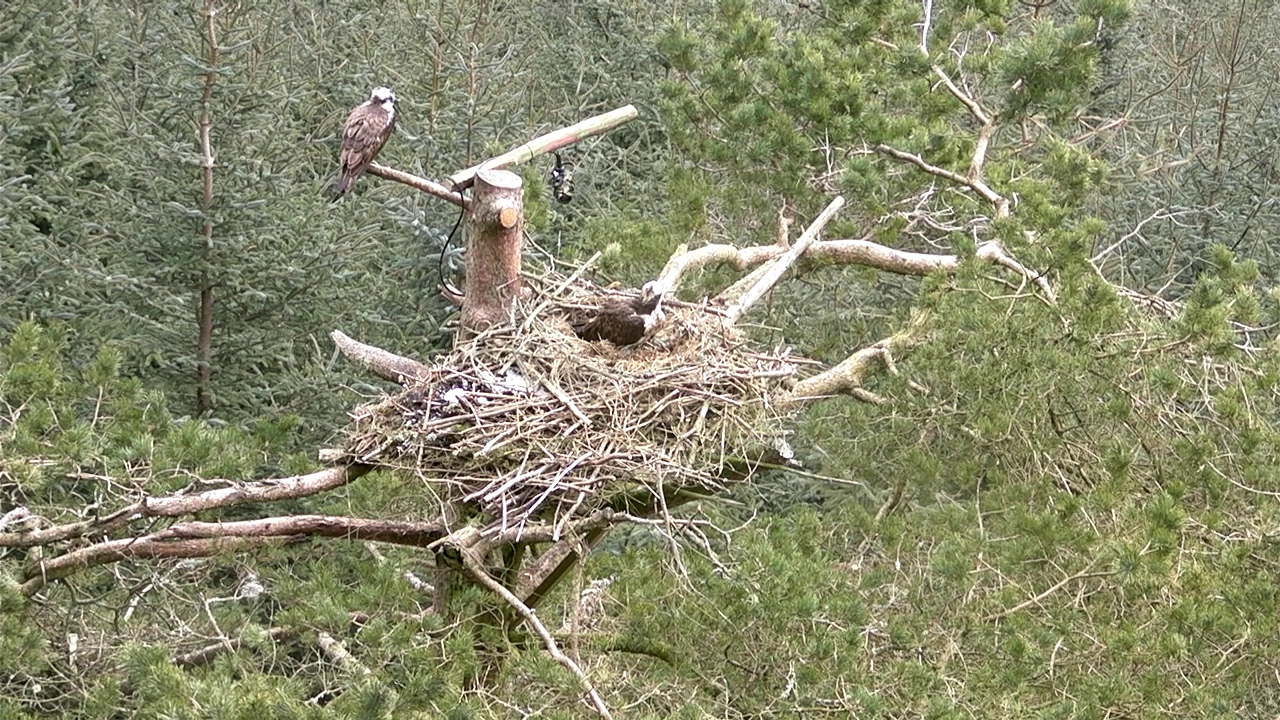
During this period a lot of nest scraping takes place and fiddling about with sticks to move from one side of the nest to the other, possibly a way to occupy the time. It is easy to tell the difference between the adults not just because the male has the leg ring white SS but he is about one third smaller than the female and has a pure white chest, whereas the larger female has a streaked chestnut band of feathering on her chest and the markings on the back of her head crest look like a chocolate coloured concorde. 

Heron adults appear to be identical to each other, the text books tell us that the parents share incubation duties but we have never witnessed a swapping over at the nest, so perhaps this only happens infrequently. We have not witnessed any interaction between parent birds and never know if it is the male or the female that is sitting on duty. Apparently the male heron is the larger of the two but only really noticeable in wing length and beak length which is not obvious at all when they are sitting incubating. Both birds are strikingly handsome with long black head plumes and sleek grey plumage with streaked black, speckled, neck feathering. They sit motionless when incubating for long periods and often we double check that the camera is still working, when suddenly, the bird will stand and reach down to turn the three blue/green eggs.
Osprey incubation takes between 37 and 42 days and the first egg was laid on 12th April, so we can expect that the earliest likely hatching date for the first egg could be 19th May.


Kailzie Osprey and nature watch

The heron eggs were laid on 20th April, 24th and 27th April and they take 25 to 26 days to incubate, meaning that we will have live hatching on camera anytime from the 16th May. Because they have nested so late this year it will be the first time we have ever seen the heron chicks when they have just hatched. We are very excited about watching the heron chicks develop this year as we get to see the family raised right from the very start. Heron siblings behave with a great deal of rivalry and there can be many dramas, often with older siblings killing off younger ones and even eating them.

Ospreys have never displayed such behaviour in the nest in the ten years that we have watched this family. The parents are very attentive to their young whereas the heron parents have a very different approach, delivering food and leaving the chicks for long periods in the nest alone.

The camera nest box became occupied with a blue tit nest building very early in April and then all activity seemed to come to a halt. The warm sunny weather seems to have kick-started the nesting imperative and the blue tit has been seen actively nest building again, although we have not seen any eggs yet. It would appear that the cold snap has caused the blue tit to delay laying which is good because they need to wait until there is a plentiful supply of caterpillars to feed any young. Last year they were caught out by laying early and the wet weather meant there were no caterpillars. We watched as one chick after another starved and the sad image of the blue tit removing dead nestlings is hopefully not to be repeated this year. Populations do fluctuate due to seasonal variations but over time should even out.

Friday, 3 May 2013

Three eggs each for our ospreys and herons!


Male brings a fish for the female and then takes a turn to incubate.
The ospreys have settled in to a routine of incubation shifts at the main nest now that they seem to have reached a full clutch of three eggs. The camera has been remotely switched on to the close up view, so we now have stunning views into the nest. Much of this month will be taken up with incubation duties and it is always a pleasure to watch the swap over as the parent in the nest stands off the eggs, gently curls in their talons to make sure that they do not accidentally pierce the eggs and then carefully backs out of the nest as the next shift is deftly taken over by the other waiting parent bird, who quickly takes up the incubation spot and continues to keep those precious eggs warm.

The appearance of the sun and a spell of warm weather will be most welcome to ospreys all around the region as when reviewing last years’ report of nesting activity in the area it would seem that one of the factors affecting nest failure correlates to poor weather. Of a possible ten osprey nest sites as part of the Tweed Valley Osprey Project, only seven were successful in rearing young last year. Of the seven successful sites, all were early returners from their migration and had time to take full advantage of the early warm spring that we had last year. The disastrous wet summer that followed made it very difficult for not just ospreys but for many invertebrate feeders too.

Male white leg ring stands to reveal 3 eggs

Our male bird, White leg ring SS is fifteen years old this year and he came from a nest in Aberfoyle originally, he is with his unringed partner and this is their tenth season together. They have raised 23 chicks in total since they got together and there will be three more to add to the list this year if all the eggs hatch out.

To date, we can celebrate that the Tweed Valley Osprey Project has raised a minimum of 160 osprey chicks since the start of the project in 2000. This is a fantastic conservation success story for the region and it is thanks to the Forestry Commission Scotland, in particular to Tony Lightley, Conservation Manager for South of Scotland and his team for creating nesting platforms to encourage the ospreys to breed here, monitoring sites and ringing the chicks.

The project is a partnership between Forestry Commission for Scotland , Kailzie Gardens and RSPB working together to provide the public viewing centres and trained volunteer staff who educate the public all about this great project and help to spread the news of the amazing story of the return of the iconic ospreys to full breeding success here in the Borders.

We are very grateful to Bill Irvine and his technicians from FCS because they do all the technical work, setting up the cameras and making the live images possible in the viewing centres with amazing new technology.

Heron turning her three eggs.
The centres are open daily from 10am to 5pm. On camera across the two centres there are the heron nest with three eggs, blue tits that are still nest building, jackdaws with 5 eggs, pond camera, meadow and river camera, and bird feeding stations as a constant hub of activity.


Golden Eagle flying over Innerleithen - photograph by Jan Lister
Golden Eagle flying over Innerleithen - photograph by Jan Lister
Another exciting bit of news for the area was the presence of a white tailed sea eagle spotted flying over Cardrona Forest in the Tweed Valley on 10th April, this was reported in the bird listings, in Birdwatching magazine, so it is a reliable record.

Last year on 13th April, a Golden Eagle was photographed by Jan Lister as it flew over Innerleithen Town and she kindly sent the photographs to us at Tweed Valley Osprey Project. This is another exciting species to add to the list for the area.


Friday, 26 April 2013

One, Two, Three Osprey Eggs!

The ospreys now have three eggs and the season looks set to be on course for early chicks again this year.

Our ospreys acan be viewed live via our camera viewing
facilities at our two Wildwatch centres at Kailzie Gardens
and Glentress
  This is in contrast to the lateness of all of our other breeding birds which have been delayed by the poor spring weather.

The ospreys are doing their shared incubation duties at their tree top eyrie, they are very territorial at their nest site and will not tolerate other ospreys coming too close. They defend their site rigorously with posturing and flights to scare off any unwelcome ospreys in the vicinity. Other ospreys often will pop over to have a look at other sites in the area, known affectionately as ‘buzzing’ the nest. Often, it is just harmless nosiness but the territorial pair need to safe-guard that it is not a serious attempt at site stealing.

The female osprey has been hunkered down deep into the cup of the enormous nest to keep her eggs safe in the high winds while the male continues to bring in fish. The weather has meant that the main rivers such as the Tweed have been in ‘spate’ and too difficult to hunt from but he seems to have secured a good loch from which to provide a steady supply of fish.
Heron nest with eggs
Two heron eggs
The herons have only just laid their eggs and the nest that is on camera now has two beautiful bright blue eggs with a very proud mum. When she laid her first egg, volunteers on duty at the Kailzie Gardens Osprey and Nature Watch Centre, watched and said that she stood up and peered down below and seemed surprised at the sight of an egg there. The herons are very late nesting this year and would normally have chicks by now. But the lateness does not seem to have hampered their progress in any way as mum appears to be in fine breeding condition and is settled at the nest site and has begun to incubate. They nest in a heronry, a colonial nest site with other family groups. Sometimes the female will leave the nest and take a flight to the flooded pasture to forage for food. We have been able to follow this activity on the meadow camera.


The jackdaws have taken up residence in the owl box at Glentress and this can be seen in the Wildwatch room in the Peel Centre, on the windows on wildlife cameras. They now have 5 eggs, which will take up to 18 days to incubate. It will be fun to watch the antics of this lively little family on camera over the next few weeks.

The pond camera in Kailzie has revealed that the frogs have left masses of frogspawn and the pond camera at Glentress which was showing lots of toads in the water now has long strings of toadspawn on the rocks. This will be interesting to watch as the spawn develops and the little tadpoles break out and become free swimmers.

More volunteers are needed to help to staff the two centres and if anyone is interested in becoming a volunteer please get in touch with Tweed Valley Osprey Project Officer, Diane Bennett by email on Tweedvalleyospreys@gmail.com


Wednesday, 17 April 2013

Two eggs now and counting!

A second egg has been spotted in the nest and this was first seen late on Monday 15th April when the volunteer on duty at the Glentress Wildwatch room realised that when the female was turning what he thought to be one egg, there were actually two! We will keep a watchful eye for more eggs over the next few days.

Ospreys at the nest now with two eggs
Proud Dad to be looks down as female reveals 2 eggs

The birds have begun their incubation duties and as ever the male bird from this pair is always keen to take his turn. Both birds appear to be relaxed and very settled. The eggs are gently and carefully turned regularly and the adult birds curl their talons in, to make sure that they do not accidentally pierce the eggs while they lean down and roll the eggs into a favoured position using their beaks.

The weather has been very stormy with high winds. The female has been hunkered down into the nest cup which she frequently scrapes and shifts about material, so that it is to her liking. The male bird has been perching above the nest looking down like the proud father to be.

More wildlife news from around Tweed Valley

The pond camera at Glentress is now showing lots of toads mating in the water. The one at Kailzie has revealed masses of frogspawn and frogs lumbering about.

Heron on the nest
Breeding condition - Bright orange base to the beak
At Kailzie Osprey and Nature Watch Centre, the ‘live’ heron camera is giving superb views of the female heron in impressive breeding condition.

Her beak has a very bright colouration with a vivid orange base and yellow tip. During rest periods at the nest she has been seen resting her long beak on the sticks in the nest. She continues to re-arrange the sticks and there is a lot more fresh grassy material which has been added to the top. There has been no sign of any mate, but she certainly gives the impression of a bird with egg laying on her mind!

The first swallows appeared hunting over Kailzie fishery today and the blue tit has begun to build her nest in the nestbox with a live camera link into the centre at Kailzie.

Monday, 15 April 2013

First Osprey Egg of the Year!

Female stands to reveal egg
At just after 3pm on Friday, the female osprey laid her first egg. Two volunteers were at the centre and spotted the egg when the female stood up.

One of the volunteers is new to the project and so this is a lovely surprise for her to be the first to see the egg and a great start to the season.

We believe that this may be the first osprey egg this year in the Scotland. The Tweed Valley birds have wasted no time since their return and have been spotted frequently mating at the nest site. We will keep a watchful eye for more eggs over the next few days. 
Male flies off with fish.


At around 5.30pm, the male was up on the perch next to the nest with a fish and taking a leisurely meal while the female took her place, to begin incubating straight away. Both birds appeared to be relaxed and very settled. 

Egg rolled into position and female begins to incubate again.
 
The male flew off with his fish and a few seconds later the female stood up, peered down between her feet and began to nudge the egg with her beak to turn it, which was clearly seen. She soon settled back down to incubate again, very satisfied that all is well and the position of the egg is just as she would like it.

Wednesday, 10 April 2013

Waiting for an egg to be laid as our ospreys settle in for the season

The osprey pair at the main nest have settled in to their tenth season and can be seen sitting close together at the eyrie - their massive nest on top of the Scots Pine, that will be their home for this coming summer.


New Perch at the nest.
The pair seem very settled and have been mating at the nest site. We are expecting to see an egg any day now.
 
They have taken short trips away from the nest to bring back some nest adornments of sticks and mosses and now the centre of the nest is beginning to look quite snug in readiness for laying.  

The snow has mostly melted, although it is still  a very sharp, cold spring. However, all seems well set for the start of the breeding season.

The camera has been set up high this year so that we can get a good view in to the nest. 

There has been a new perch added to the side of the nest too (see pic) which the birds have found very much to their liking. It gives a super view of the ospreys when they are there. 

The new cameras are relaying images ‘live’ into the centres at Glentress Forest and at Kailzie Gardens and the quality of the picture is excellent due to the use of high definition.

Wednesday, 3 April 2013

Ospreys return to Tweed Valley for a 10th season

The Tweed Valley Ospreys have returned for their tenth season at the main nest site which is viewed live on camera.

The severe weather conditions in the Tweed Valley this spring has meant a delay in setting the cameras up at the main nest site, as the snow made it impossible for the technical team to get near enough to the cabling and mast to switch on. Luckily the team had renovated the nest site in readiness for the return of the birds earlier in the month before the snow came and the cameras had already been installed but connections had not been sorted out when the weather took a turn for the worst.

Today though, we finally managed to have cameras rolling and a great sight at the nest was the presence of our two ospreys back for their tenth anniversary year together. The nest does not look inviting at all, with over a foot of frozen,compacted snow sitting on top of it! The pair were seen at the perches to the side of the nest and have wasted no time, as we witnessed mating taking place. The female was also seen eating a good sized fish while the male bird surveyed his domain from the lofty perch to the side of the nest.

It is always a huge relief to see the birds back for the first time at the start of the season, particularly after such a harsh spring. Both birds appear to be in fine form and the female as always looked very impressive as she turned to camera showing her raised crest and piercing yellow eyes.

Both centres at Glentress Peel and Kailzie Gardens Osprey & Nature Watch are now open for the public to view these magnificent pair live on camera at their eyrie and enjoy the intimate moments of family life at the nest.


Wednesday, 29 August 2012

Farewell for this season


This years osprey brood not long after hatching
 The nest has been empty now for the past few days and although the young birds are likely to still be around, we think that the parents have now left.

Staring at the empty nest, we are reminded that these magnificent birds are only really, truly ‘our Tweed Valley Ospreys’, for part of the year, as they will be spending the next six months in Africa. I wonder do the local people in Africa refer to ‘their birds’ returning?

In reality, we share the pleasure of this international family. It should be a happy time to see the birds have left after another successful season, another brood of chicks raised and off to make their way in the world. But for the volunteers and staff at the osprey centres, it is always tinged with a slight sadness to see them go and we hope that the adult birds make it back safely next spring.

All that remains is to sincerely thank all of the volunteers that have staffed the centres this season. Some of the volunteers have been faithful to the Tweed Valley Osprey Project since the very start. Also, each year we manage to recruit a few new volunteers to the project and we are very grateful for their support and their enthusiasm to share the news about the osprey antics with visitors.

It is my last day for working on the osprey project for this year and I hope that everyone has enjoyed hearing the weekly osprey family updates.

Thank you for supporting the Tweed Valley Osprey Project,


Until next year, bye for now,

Di Bennett,
Tweed Valley Osprey Officer.


Thursday, 23 August 2012

Migration time for our ospreys

Migration for ospreys has started now and birds from further up north will be passing through the area on their southward journey to spend winter in Africa, in areas such as Senegal and the Gambia. Here, they will live a colonial existence, fishing in the swamps and languishing in the good weather, to avoid the harsher winters of Scotland.

We had thought that the female osprey from the Tweed Valley main nest had departed already but she made a very brief appearance at the nest on Sunday 19th. Both adult ospreys must spend this time preparing for their migration, by feeding up and getting into prime condition. The young must now fend for themselves, as they are due to make their solo journeys to Africa for the first time. This is a daunting task to embark upon, when so far their lives have proved to be quite idyllic here in the Borders. They have had the luxury of doting parents, they have been well fed, grown up in an undisturbed eyrie and now they are finding their way in the world, to explore this lovely area where they have been raised. They face many hazards and situations that they will have to deal with, as well as finding good food sources along the way.
A lone chick at the eyrie
We hope that good weather assists them for their first migration so that they make a safe crossing over large water bodies and avoid desert landscapes as much as possible.

Once the young ospreys have made one successful journey, the knowledge and experience that they have gained will help them for future passages and they will select their own favoured routes with good stop over sites. The journey can take up to a month to complete before they settle into wintering grounds. The young birds may not return until they are two to three years old and they would be unlikely to breed successfully until at least aged 3 to 4 years old.

Once settled into a nesting territory they can live well into their twenties and make lifelong partnerships.

The main nest birds have been together for nine years and they have remained faithful to each other and to the nesting site. Next year will be the 10th anniversary of the osprey pair and also the 10th anniversary of the Osprey Centres, so the Tweed Valley Osprey Partnership of Forestry Commission for Scotland, Kailzie Gardens and RSPB we will be planning a joint celebration event to mark the occasion.

Follow us on Twitter and via the FC Scotland Facebook page for updates on the 10th Anniversary celebration.

Friday, 17 August 2012

Our young ospreys getting to grips with the art of hunting


Osprey Talons
The young ospreys are now proficient flying hunters. They have had a few weeks to explore the Borders terrain and discover all of the fishing hot spots with their parents.

The weather has finally given them a break to practice hunting and spotting fish in the water from a good height and then aim their plunge dive technique, to lock on to the unsuspecting fish below and pluck it from the water.

The fish are caught in their mighty talons and then they manoeuvre their toes to face the fish in a forwards direction to carry it off in a streamlined fashion. This is quite a skill to master and to be able to fly with a live wriggling fish between their talons too. The technique is naturally aided by the birds finely designed feet, sporting growths called spicules, which act as sticky pads onto the fish, so that it doesn’t slip from their grasp.

We have seen chicks recently landing on the nest with fish and we are assuming that they are catching this prey for themselves, although we have also witnessed the parents drop in with an occasional fish also. So, it could be that they are still being supported by their parents as well as catching some of their own.

The adult birds will be leaving for their long haul migration to Africa soon. The female is usually the first to break up the family unit and may well have already left. She was last seen on Friday 10th August. The chicks are still coming to the nest, so we are confident that the male is still around because the young birds wait and hope that he will pass a fish over to them. The nest stands empty for quite long periods of time and then suddenly a chick will fly in and land and will begin calling excitedly, which must be because an adult or a sibling is nearby with a fish.

One of the young ospreys looks to be smaller than the other two chicks and at the time of ringing, it was thought that all three chicks were female because they were a good weight and size but possibly now that they are grown, the smaller one may turn out to be a male bird.

You can view footage of these magnificent birds before they head off on their long journey via our webcam .

Wednesday, 15 August 2012

Cheeky intruder at the osprey nest!


Visitors to the osprey eyrie have included a jay family and this week a juvenile great spotted woodpecker.

There are frequent coming and goings from the osprey chicks at the nest site whenever they are hungry. The parents have been at the nest site regularly too and the male brought in a fish on Sunday which the female took and flew off with it. They seem to keep their strong pair bond this
late into the season even though their instinct to prepare for a long migration journey is imminent. It is usual for the female to be the first to break up the family unit and head south once the chicks have fledged and have been flying for a few weeks. Perhaps having had such a very early brood means a longer stay in Scotland for the adult birds. This slow end to the season will allow for plenty of time for the adults to gain peak condition for the flight to Africa. The young birds will also have extended time to hone their skills before making their perilous first migration journey.

David Allan who is one of the Osprey Project volunteers sent this message to me yesterday, ‘ Just to let you know, we had a rather unwelcome intruder at the nest this afternoon . . . . a GREY SQUIRREL!

It appeared around 3:15pm, and hung around the nest for a couple of minutes. The female was on the nest at the time with a fish. I don't know who got the bigger shock when the squirrel appeared over the edge of the nest!

Live images of the osprey nest can be viewed via our webcam which is available from 8am to 6pm

Wednesday, 1 August 2012

Young ospreys left home alone and visits from the Jay family


Two jays check out the empty nest.
The osprey eyrie is sometimes unoccupied by the osprey family when they are out on a fishing foray. This leaves a desirable residence open for exploration from other species checking it out.

The jay family which presumably nested quite near to the osprey family, have been frequently seen at the nest, moving sticks about and pecking around on the nest floor to pick up any titbits.


One of the jays flew on to the nest and was startled by the arrival of one of the osprey youngsters. The bold jay nonchalantly moved towards the edge of the nest and as it gained confidence and felt less threatened by the presence of the osprey, slowly made its way back to the middle of the nest, just pecking at the sticks. Then both osprey and jay flew off at the same time but parting in different directions.

On Monday 30th July, two of the young ospreys were at the nest with a fish each and were feeding themselves. There was no sign of the parent birds and so there is no way of knowing whether these young birds had caught the fish for themselves, or if parents had given the fish to them. They both arrived at the nest with the fish. The third young osprey flew in to join her sisters but one of them took off presumably not very enthusiastic about sharing her dinner!


Chick all alone in the nest squawking loudly.
There can be long periods of squawking from the chicks as they hang around the nest site waiting for food. Sometimes they may perch to the side of the nest and call loudly. We cannot see if there is a parent nearby but assume that there must be and that the young birds are begging for food.


There are occasions were the birds appear to look skyward and begin to alarm call and this could mark the presence of intruder ospreys or other perceived threats such as buzzard or maybe goshawk nearby. There have not been any incidents that we know of at this site, or of any intruder birds actually coming down to the nest this year, although in the past other ospreys have popped down to check out the site.

At the Osprey Centres

Young great spotted woodpeckers have been seen coming to the bird feeders regularly at both Glentress and Kailzie feeding stations and they seem to favour the peanut feeders. A hedgehog has been patrolling the area outside of the Kailzie Osprey and Nature Watch Centre and even had a snooze in the hedgehog box!

There is a clear path from the hedgehog box to the pond edge where it must come for a drink. Young birds seem to be everywhere at this time of year and they are rapidly spreading out to make up roving mixed flocks feeding through the woodland areas.

Soon the wader families of oystercatcher, lapwing and curlews will abandon their upland home for a more coastal and estuarine habitat for the autumn.

Tuesday, 24 July 2012

Osprey manners missing at feeding time as chicks resemble rebellious teenagers!

Lunchtime feeding at the osprey eyrie seems to have lost the orderly and civilised manner we have become familiar with over the course of our young chicks growing up. The youngsters now resemble rebellious teenagers all shouting to each other excitedly across the table at meal times!

Our hungry chicks at feeding time
The female (Mum) brought in a good sized fish. We don’t know if Dad had caught it and given it to her, or whether she caught it herself. She flew on to the nest with it and was soon joined by three extremely noisy youngsters. The boldest chick took the fish from her and began to feed itself avidly.
The whole time our bold chick was tucking into the fish, the other two just squawked and created a rumpus. Mum decided that she would like to take the fish back. The chick took on an aggressive stance and faced down her mum, as she mantled over the fish and held onto it in her talons! Her mum backed off and flew from the nest. Once the chicks’ appetite was satisfied, she let go of the fish and moved away.

The next chick quickly seized the opportunity and grabbed the half eaten fish and began to eat , leaving chick number three to really squawk and complain loudly throughout her sisters feeding. Mum returned and it looked as though she was about to take the fish again. We thought that she was probably going to ensure that the third chick was fed, however, her intent was actually more about taking the fish for herself! When she was unsuccessful again, she took off and left the chicks to continue.

After about twenty minutes the second chick lost interest in feeding and thankfully chick number three managed to grab the remaining third of the fish to feed.

This is a great time of year to watch out for families of ospreys out and about near water bodies in the Scottish Borders and particularly around Tweed Valley. Fledged, hungry chicks will be honing their skills for flight and to master fishing techniques. Mostly they will rely upon their parents to catch the fish for them but they must watch how they do it and learn very quickly. Soon the parents will be less keen to share their supplies as they will need to build up their own reserves for the return journey to Africa. Hunger will eventually drive the young birds to fish for themselves. It is a hard lesson for them and their survival depends on it.

Tuesday, 17 July 2012

Successful first flight for our three osprey chicks

On the first day without rain (12th July), two of the osprey chicks took to the skies at last, followed later in the day by the third chick.


Our three chicks at the nest after a successful first flight
 It is always a very worrying time when the birds make their first flights as they can crash land and struggle to make lift- off again. The birds were away from the nest for a considerable amount of time and we waited in anticipation to see if the family would return safely.

The day after their debut flights all of the family were seen back at the nest and all were looking healthy and well. A safe first adventure for the youngsters and this has now set them well on their way to full maturity. They will spend their time from now on familiarizing themselves with the landscape and following their dad to learn fishing and hunting skills.

On Monday 16th July, the whole family were together at the nest. Dad had brought in a good sized fish and the boldest chick (CK1), seized upon it and began to tear off strips of flesh and feed herself. She continued to feed until she was full, before mum took the fish from her during much squawking and complaining and proceeded to share the rest of the fish by tearing off bits and offering them to the two other chicks one at a time.

The family altogether at the nest are an incredible sight and the young birds are now fully adult sized. The female brood are bigger than their Dad. They have been nicknamed the ‘Pointer Sisters’, as we waited for such a long time for them to ‘go ahead and jump’, to make their first flights!

Of the three chicks, the most dominant and leader of any activity is the chick with leg ring CK1. She was the first to fly, the first to feed herself and she takes off from the nest first after feeding. She is a bold bird that will hopefully have good survival instincts to ensure a long life.

Wednesday, 27 June 2012

New osprey chicks are ringed

Tweed Valley Osprey Project volunteers at yesterdays ringing
Tweed Valley Osprey Project volunteers
 at yesterdays ringing
Yesterday, the young osprey chicks in the main camera nest were ringed.

Tony Lightley, the conservation manager from Forestry Commission for Scotland led his team to the nest, where under special licence, Tony was able to climb to the top of the nest tree and remove the chicks and lower them to the ground below where they were fitted with two leg rings each. On their right legs they received a unique British Trust for Ornithology Ring which is indestructible and bears a unique reference number, and on the left leg they each received a large blue coloured Darvic ring with white lettering.

The three chicks from our main nest were given the following leg rings, CKO, CK1 and CK2.

These rings will help to monitor the progress of the birds over the course of their lifetimes. If the birds are spotted and a note made of their leg ring number this can be sent to BTO (British Trust for Ornithology) and the ringer of the bird will be contacted to let them know. This is a great tool to scientifically track the distribution of ospreys and find out about how long they live and where they are migrating to; and often information can be gleaned about other places birds may turn up along their migration routes at stop off feeding places.

The chicks were also measured and weighed and from this information we believe that all three chicks may be female. They are very big chicks and well fed and feathered. It is estimated that they will be likely to fly in about another weeks’ time.

A selection of volunteers are invited to attend the ringing each year, as a thank you for staffing the centres at Glentress and Kailzie. All enjoyed the experience very much and were delighted at seeing the chicks.